Perched atop the butte of Montsec, this monument rises above a landscape once shaped by war. Built on ground fought over during two world wars, the memorial transformed strategic terrain into a permanent place of reflection and remembrance visible for miles arou...

Dedicated in 1932, the Montsec American Monument commemorates the service of American forces who fought in the St. Mihiel region in 1917 and 1918. Villages liberated by American troops are carved into the monument’s exterior, linking remembrance directly to the ...

Designed by architect Egerton Swartwout, the monument’s monumental circular form was encouraged by ABMC Chairman John J. Pershing, who believed the commanding site required a memorial of greater scale and permanence. Damaged during World War II, the monument was...

Gold Star Mothers visit the Montsec American Monument.

The monument, built to honor World War I, became the scene of fighting in World War II when both sides used it for defensive positions and artillery observation. Battle damage to the monument was repaired by the Commission after the war, restoring it to its orig...

Symbols carried memory forward.
Inside the monument, a bronze relief map and division insignia connect visitors to the military operations fought across the surrounding landscape. One insignia belongs to the 42nd “Rainbow” Division.

Originally represented by a full rainbow symbolizing troops drawn from across the United States, the division later adopted a half-rainbow design after suffering heavy wartime losses, transforming its insignia into a lasting symbol of sacrifice and remembrance.

During 1917 and early 1918, the Rainbow Division’s insignia was actually a full rainbow, symbolizing the service members from across 27 different National Guard units coming together to form it. The 42nd Division took part in four major operations and throughout...
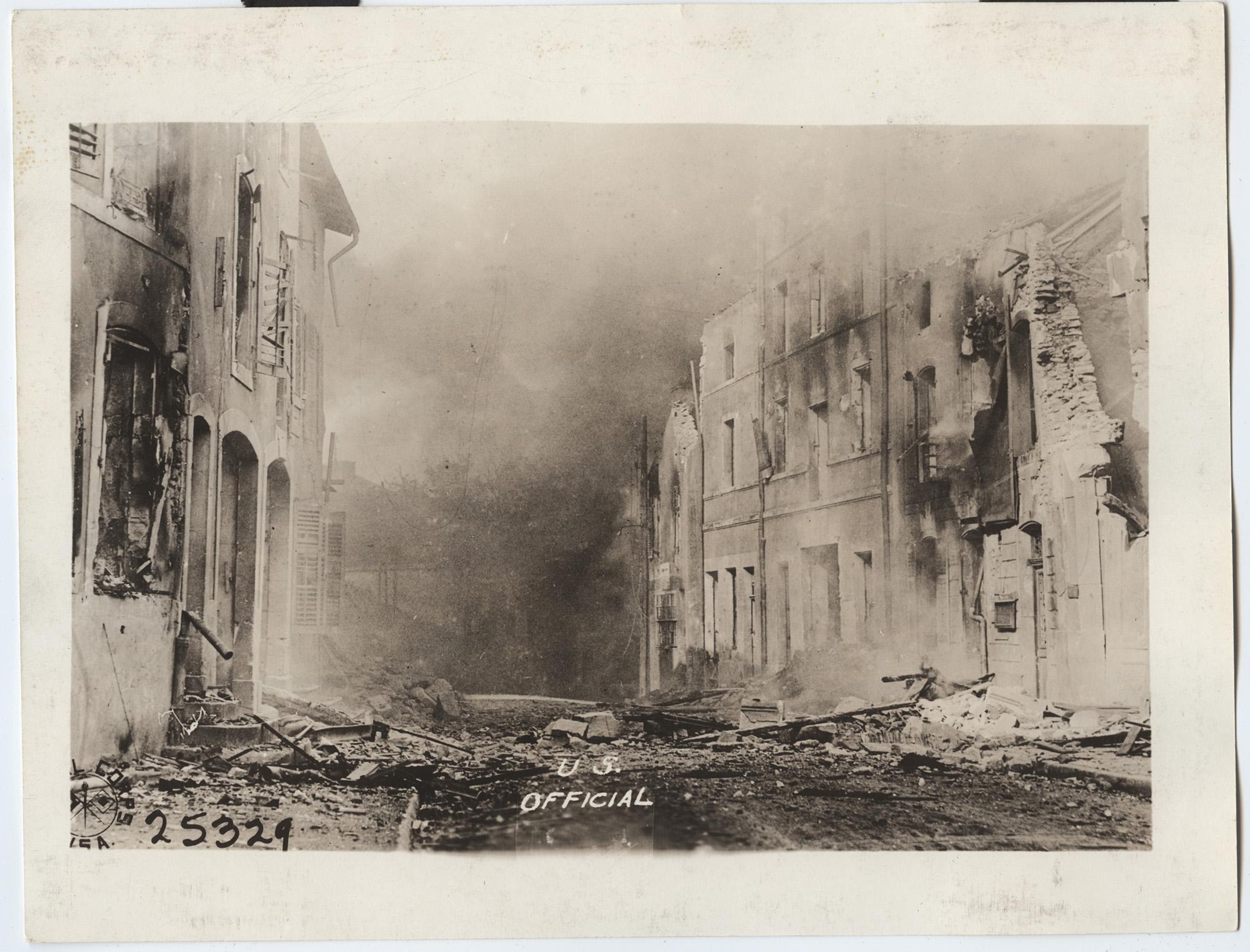
Beginning on Sept. 12, 1918, the St. Mihiel Offensive became the first large-scale operation led primarily by the American Expeditionary Forces (AEF). American forces successfully reduced a German-held salient (a section of territory extending outward into nearby French territory).
The offensive demonstrated growing American military coordination and highlighted the importance of artillery, logistics, and mobility before the larger Meuse-Argonne Offensive.
Attribution: Object ID: 1976.227.279