


Letters
It arrived in the mail
For many families, grief first arrived through letters. Fellow soldiers, nurses, and aid workers attempted to explain loss, preserve personality, and provide comfort across great distance.
Imagine opening an envelope and finding a life summarized in ink. What would you look at first?
- Slide 1 of 5

Letter, Thomas F. Darcy Jr. Writing home for the dead. Letters from nurses, soldiers, and officers became memorials themselves – preserving bravery, humor, friendship, and the final moments families could never witness firsthand. Transcription : Germany Jan 2-18...


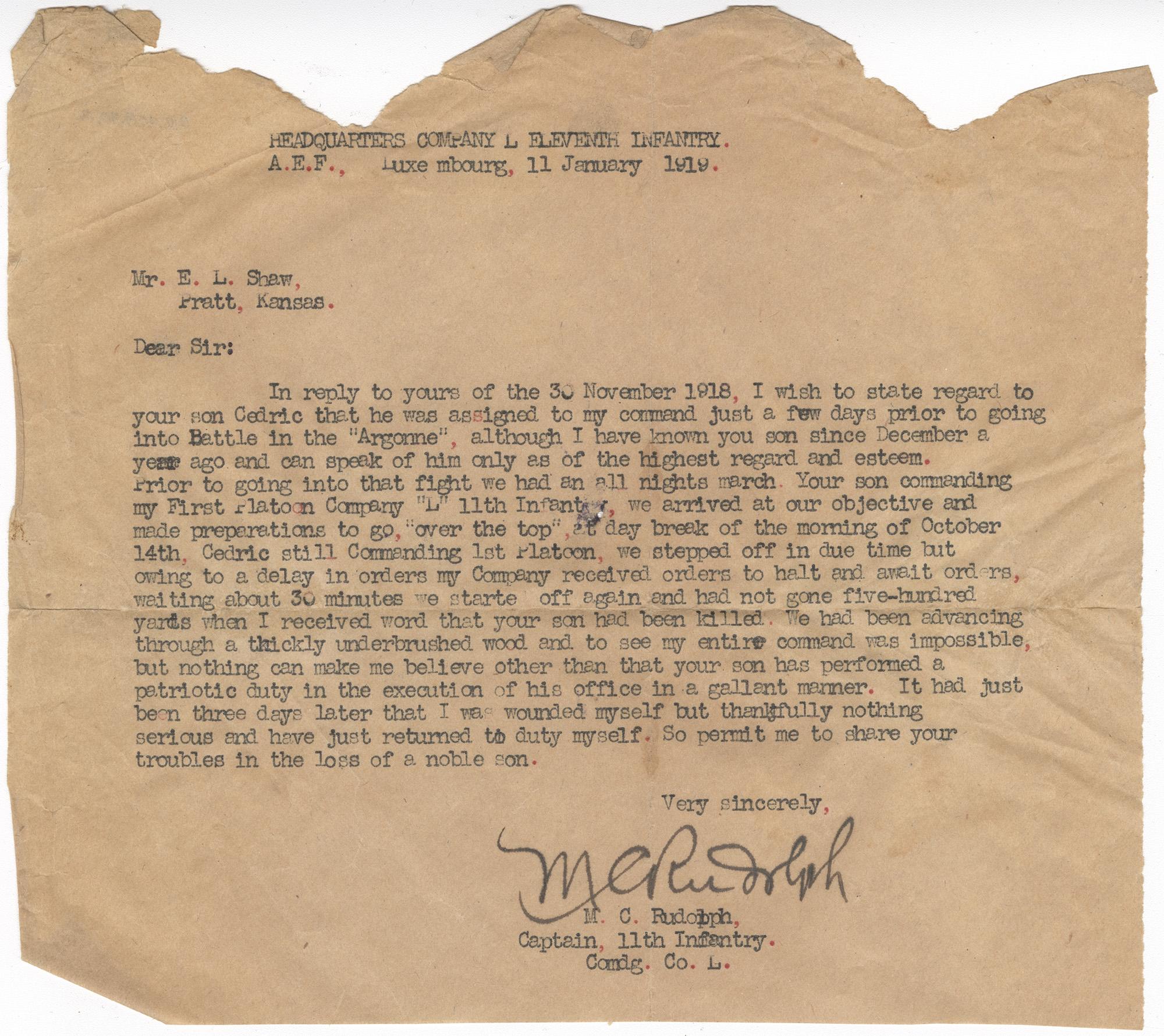
Letter, Captain M.C. Rudolph
What would you want someone to say about you after your death?
Captain M. C. Rudolph wrote First Lieutenant Cedric Shaw’s family after they reached out seeking someone who had known their son and could tell them of his final days. In this letter, Rudolph offered comfort and assurance of their son’s courage and valor on the battlefield, sharing in the family’s grief over his loss.
First Lieutenant Shaw enlisted in the U.S. Army in August 1917 and served until killed in action in October 1918. First buried on a nearby farm in France, Shaw was later reinterred at the American Cemetery at Romage, and finally returned home to Pratt, Kansas and laid in his final resting place in September 1919.
Transcription:
HEADQUARTERS COMPANY L ELEVENTH INFANTRY.
A.E.F., Luxembourg, 11 January 1919
Mr. E. L. Shaw
Pratt, KansasDear Sir:
In reply to yours of the 30 November 1918, I wish to state regard to your son Cedric that he was assigned to my command just a few days prior to going into Battle in the “Argonne”, although I have known you [sic] son since December a year ago and can speak of him only as of the highest regard and esteem. Prior to going into that fight we have an all nights march, Your son commanding my First Platoon Company “L” 11th Infantry, we arrived at our objective and made preparations to go, “over the top”, at day break of the morning of October 14th, Cedric still Commanding 1st Platoon, we stepped off in due time by owing to a delay in orders my Company received order to halt and await orders, waiting about 30 minutes we started off again and had not gone five-hundred yards when I received word that your son had been killed. We had been advancing through a thickly underbrushed wood and to see my entire command was impossible, but nothing can make me believe other than that your son has performed a patriotic duty in the execution of his office in a gallant manner. It had just been three days later that I was wounded myself but thankfully nothing serious and have just returned to duty myself. So permit me to share your troubles in the loss of a noble son.
Very sincerely,
M. C. Rudolph,
Captain, 11th Infantry.
Comdg. Co. L.Attribution: Object ID: 2019.90.2
- Slide 1 of 2

She attended the funeral for them. Red Cross workers sometimes became witnesses, mourners, and messengers for families separated from loved ones by an ocean and a war. American Red Cross volunteer Madeline Thomas wrote this letter to Private James McCabe’s famil...

Private McCabe was seriously wounded in battle in late April 1918 and sent to Base Hospital 23 to recover. Though he survived nearly two months, he died from his injuries in July 1918. He was first buried at the hospital cemetery and was later moved to the Meuse...